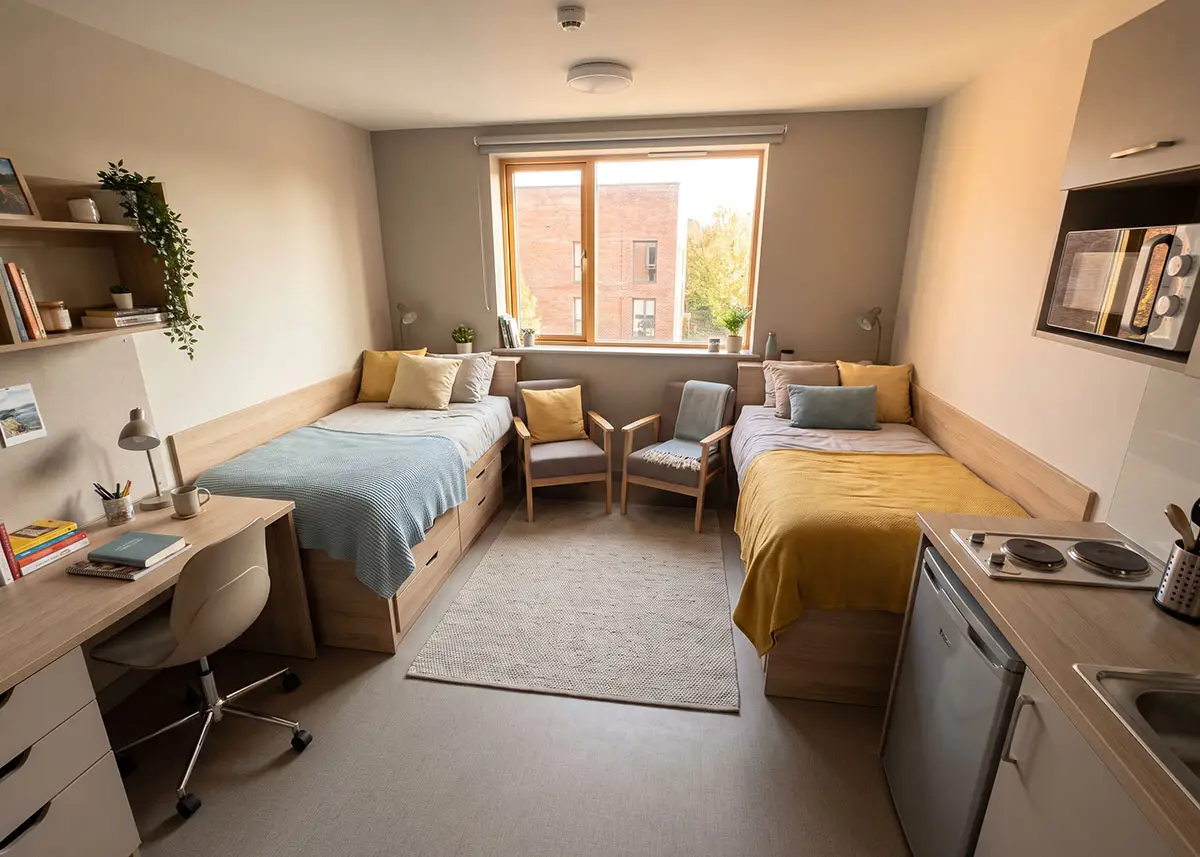
Dual occupancy means two people share one room
Dual Occupancy student accommodation describes a booking arrangement some providers offer. It lets two named residents share a studio, twin room or another eligible room type. Providers often market it to couples, though some also accept friends or siblings. Room layout, eligibility rules and price depend on the individual residence. It’s worth checking the specifics for each property rather than assuming a standard approach.
Dual occupancy shows up most often in studio-style accommodation. Studios typically include a private bathroom and kitchenette, which makes them easy to offer as a two-person option. That said, some providers build a dedicated twin studio with two beds and extra furniture. Others simply let two people share a standard single-occupancy studio. The room description is the best way to confirm which applies.
Prices can appear per person or per room
The sector doesn’t use one single pricing model. A provider might advertise rent per person, per week. Others show one total price for the whole room. Some keep the standard studio rate and add a dual occupancy supplement. Some offer dual occupancy at no extra cost.
Before booking, check exactly what the advertised amount covers. Ask whether a surcharge applies, and whether both residents need to pay separate deposits or advance rent.
The tenancy arrangement depends on the provider
Some providers name both residents as joint tenants. That means both may carry responsibility for rent and other obligations. This responsibility can continue for the whole tenancy, even if one resident moves out later.
Other providers put the tenancy in just one student’s name. They record the second person as an authorised or permitted occupier, not as a named tenant.
These two set-ups carry different responsibilities if one resident stops paying rent or wants to leave early. Read the tenancy agreement carefully, and ask the provider directly, before signing.
Providers may ask for both residents before booking
For a private dual occupancy room, providers commonly ask for both residents’ details before confirming the booking. This booking type suits two people who apply together, not room-matching.
This differs from a separate twin-room scheme some providers offer. There, the provider may allocate students to share with another resident they haven’t chosen. It’s worth asking the provider directly whether a listing is a private dual occupancy booking or a matched twin room.
Dual occupancy isn’t always the same as a twin room
Dual occupancy describes how many people can live in the room — it doesn’t automatically describe the bed layout. Room layouts depend on the provider. Some rooms have one double bed for both residents. Others have two single or three-quarter beds. Some include separate desks and storage for each person. It’s worth confirming the exact layout, alongside checking whether it’s en-suite or a shared bathroom, before booking.
Eligibility rules can apply to both residents
Some providers ask both dual occupancy residents to show proof of student enrolment. Other providers allow a partner or another non-student to live in the room as an authorised occupier.
Providers may also set conditions around relationship status, age, visa status, deposits or guarantors. Check eligibility for both people before applying.
Frequently asked questions
Can one person book a dual occupancy room on their own?
Usually, providers design the room for two named residents who apply together. Some allow a solo booking, but then charge the student the full room rate instead of a per-person price.
Do both people booking a dual occupancy room need to be students?
It depends on the provider. Some require both residents to hold a confirmed university place. Others let a non-student partner or friend join as an authorised occupier.
Is dual occupancy the same as a twin room?
Not necessarily. Dual occupancy describes how many people can live in the room, not the bed layout. Some rooms have one double bed, others have two single beds. Check the room description for the exact set-up.
Does dual occupancy cost more than a single room?
It varies. Some providers include dual occupancy at the standard studio rate. Others charge a weekly supplement, or price it entirely per person rather than per room.
Is dual occupancy the same as room-matching with another student?
No. Private dual occupancy generally covers two people who apply together and both appear on the booking. Room-matching with another resident is a separate arrangement some providers offer through twin-room schemes.
The illustration in this article was generated with AI.

